Help us create an open-source video model that predicts what happens next.
Most video AI describes what already happened. Vitua watches the first part of a clip and forecasts how it ends as calibrated probabilities across possible outcomes. Then Vitua answers counterfactuals like... what would have happened if one thing had been different?
You can easily contribute to this project by sharing a video. Content contributors will receive earliest access to models.
What the model actually does
Vitua takes a video beginning and a question prompt then returns a set of candidate video endings, a probability for each, and an explicit option to abstain when the question can't be answered (no guessing).
Ending prediction
Given the first ~70% of a video clip, distribute probability across the ways it could plausibly end... a distribution, not a single guess.
Counterfactual reasoning
"What if the support had been removed?" The model re-forecasts under an intervention prompt, rather than restating the factual outcome.
Calibrated abstention
When a question references something not in the video, the correct answer is to decline. Refusing to guess is a first-class behaviour.
Why calibration is the hard part. A model that is 90% confident should be right about 90% of the time. Most video models are dramatically overconfident. They emit fluent, certain-sounding predictions with no reliable relationship to how often they're correct. Vitua is evaluated on Brier score and expected calibration error, not just accuracy, because a confident wrong answer is worse than an honest "I'm not sure".
Where this matters
Three example settings where the useful output isn't a label but a distribution and where a model that knows when to stay quiet is worth more than one that always answers. These are directions the capabilities point toward, not deployments we've validated.
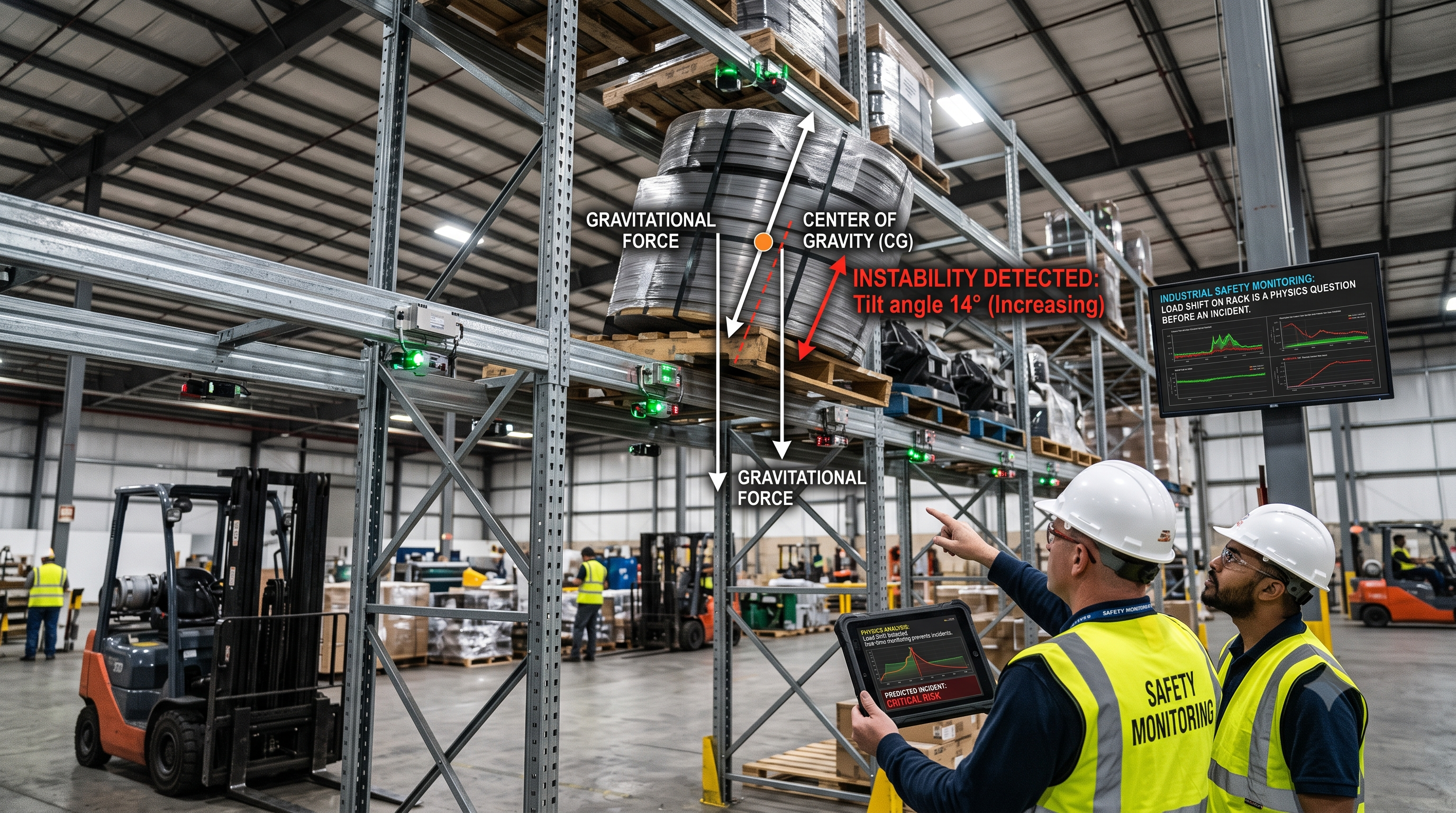
Industrial safety monitoring
A load shifting on a rack is a physics question before it's an incident. Predicting how a scene ends turns a camera from a record of what happened into a warning that it might. Abstention is what makes it usable. An occluded view should produce silence, not a guess. Otherwise the alarms get ignored.
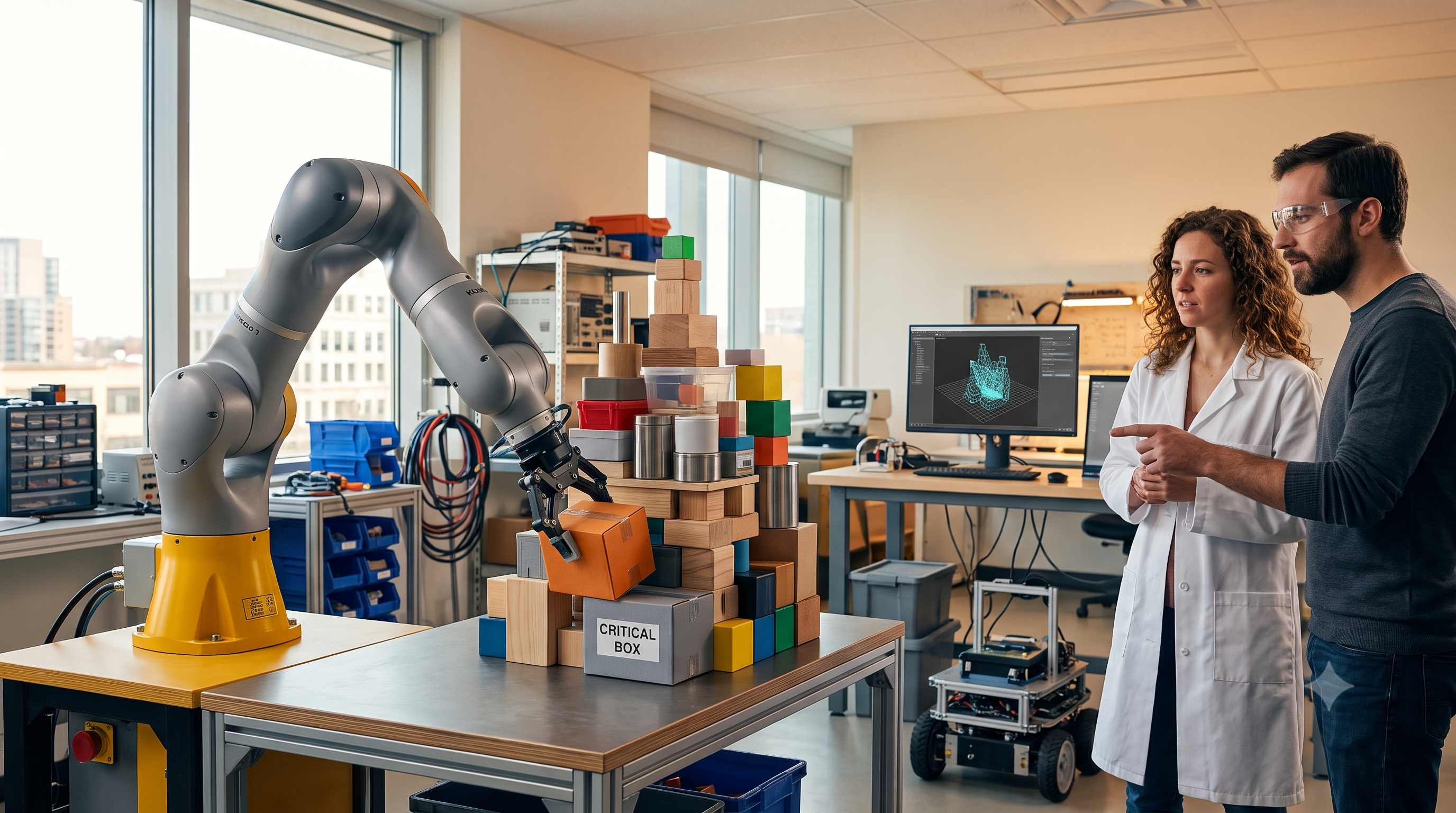
Robotic manipulation
"Will this stack hold if I pull that box out?" is a counterfactual. An embodied AI planner can ask that before moving fails in simulation rather than on the floor. Re-predicting under an intervention is the same operation whether the intervention is hypothetical or about to be executed.
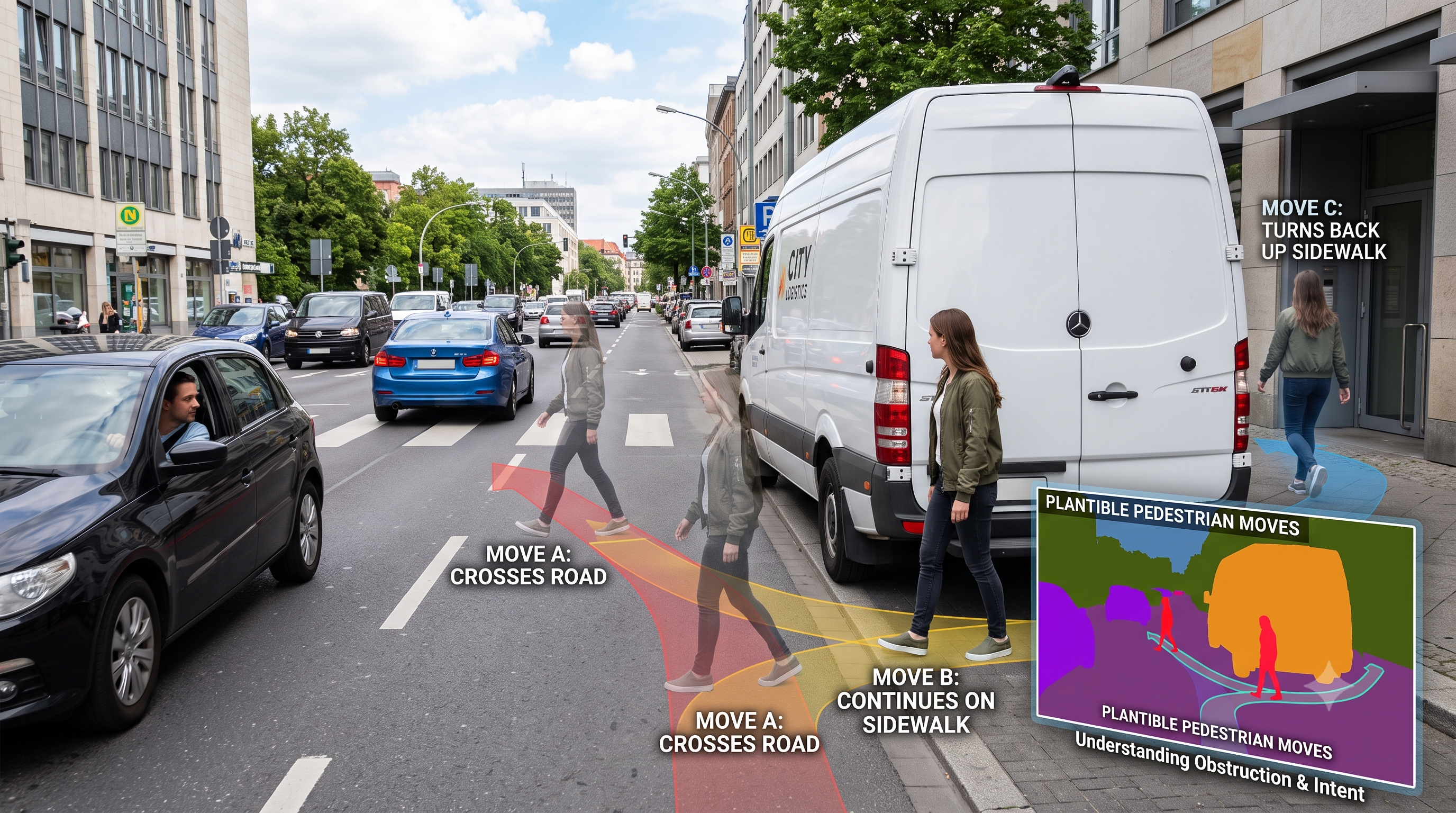
Road scene understanding
A pedestrian half-hidden behind a van has several plausible next moves, and the spread across them is the safety-relevant signal. Collapsing that to a single confident prediction discards exactly the uncertainty a downstream controller needs to drive conservatively.
The approach
The model is a vision-language backbone fine-tuned to emit a strict output contract, trained on a mixture of synthetic physics with exact ground truth and real-world video with human or model-assisted labels.
Synthetic worlds with exact answers
Simulated physical scenes where the true outcome distribution is computed by running the simulator thousands of times under small perturbations. Because interventions can be applied inside the simulator and re-run, counterfactual labels are measured, not guessed.
This gives perfect supervision, but only for a simulated world.
Real video with real messiness
Permissively-licensed real footage supplies what simulation can't: cluttered scenes, imperfect execution, varied camera angles, unpredictable lighting, and the ordinary physical events of everyday life.
This gives realism, but labels are harder to trust.
A lesson that shaped the project. An early version of our benchmark turned out to be solvable without watching the video at all. Just a trivial baseline that simply predicted the most common outcome for each question type beat the trained model. That failure is why the benchmark was rebuilt so that outcomes are balanced within every category, and why "must beat the video-blind baseline" is now a release requirement rather than a nice-to-have. Benchmarks that flatter their models are worse than no benchmark.
Why we need footage that doesn't exist yet
There is plenty of video of people doing things. There is almost no video collections with counterfactual variants: the same situation, filmed twice, with exactly one variable deliberately changed.
Ask a model "what if the cup had been tilted?" over a single video and the best it can do is produce plausible-sounding text. There is no ground truth to check it against, because the alternative was never filmed. Ask the same question when both versions exist on tape, and suddenly there is a correct answer. Paired footage converts speculation into supervision.
What makes a clip useful
| Length | 10 seconds to 10 minutes |
|---|---|
| Outcome | Visually clear outcome in the final quarter of the video |
| Context | Enough lead-up to make the outcome predictable |
| Turning point | One identifiable action that drives the result |
| Shot | One continuous take, no edits |
What makes a pair useful
Shot A and shot B share the same location, framing, lighting and setup. Between them, exactly one thing changes, the intervention.
If two things differ, the pair is unusable as causal evidence: there's no way to attribute the different outcome to a single cause. That discipline is the entire value of the contribution.
Content Rights. This is an open-ource project. Everything volunteers record enters an openly released, Apache-2.0-licensed model. That means we can only accept footage you fully own: no copyrighted media in shot, no identifiable strangers, and no children on camera. Household objects and your own hands are ideal. Contributions are not anonymous to the project. We keep provenance for every clip so the dataset's licensing can be audited later.
Claim a recording assignment
5,000 paired video assignments, each using ordinary household objects and taking about ten minutes. You'll be given one at random video capture request from the pool that nobody is currently working on.
Already claimed one on another device? Retrieve it by email.
Retrieve your assignment
Enter the address you claimed with. We'll email you a one-time link — opening it brings your assignment back. We send a link rather than showing the assignment straight away so that only the person who can read that inbox can pick it up.
-
Claim
You get one paired assignment, held for 5 days. If life happens, it quietly returns to the pool... no penalty, nothing to cancel.
Film
Two takes on a phone: baseline, then the same setup with one thing changed. Roughly ten minutes, ordinary household objects.
Upload
Send both files, mark the assignment done, and claim another if you enjoyed it. Your clips become part of a permanently open dataset.
Contributors
Every clip in the dataset was filmed by someone who volunteered their time. Counts below are pairs whose footage we've actually checked, so the table reflects work received rather than assignments marked done.
No verified contributions yet. This table fills in as the first clips arrive and get checked. If you've just uploaded, give us a few days — verification is a person watching the footage, not an automatic step.
| # | Contributor | Pairs | Contributing since |
|---|